




Sophie Adenot and the Final Chapter of the Fluid Science Laboratory
On February 27th, ESA astronaut Sophie Adenot will perform the final scientific crew activity on the Fluid Science Laboratory (FSL) on board of the International Space Station (ISS) before its decommissioning in the summer of 2026. Sophie will exchange sample cells in the Soft Matter Dynamics (SMD) experiment container, allowing the installation of new PASTA-3 sample cells for studying emulsions in microgravity.
This activity has been prepared by the operators at the Belgian User Support and Operations Centre (B.USOC) who will provide operational support to Sophie from their control centre within BIRA-IASB in Uccle.
Update 27/02/2026: Sophie's planned activity has been aborted due to irregularities observed when unpacking the sample cell units. The previous sample cell units have been put back in place pending analysis of the anomalies and a decision on the next steps.
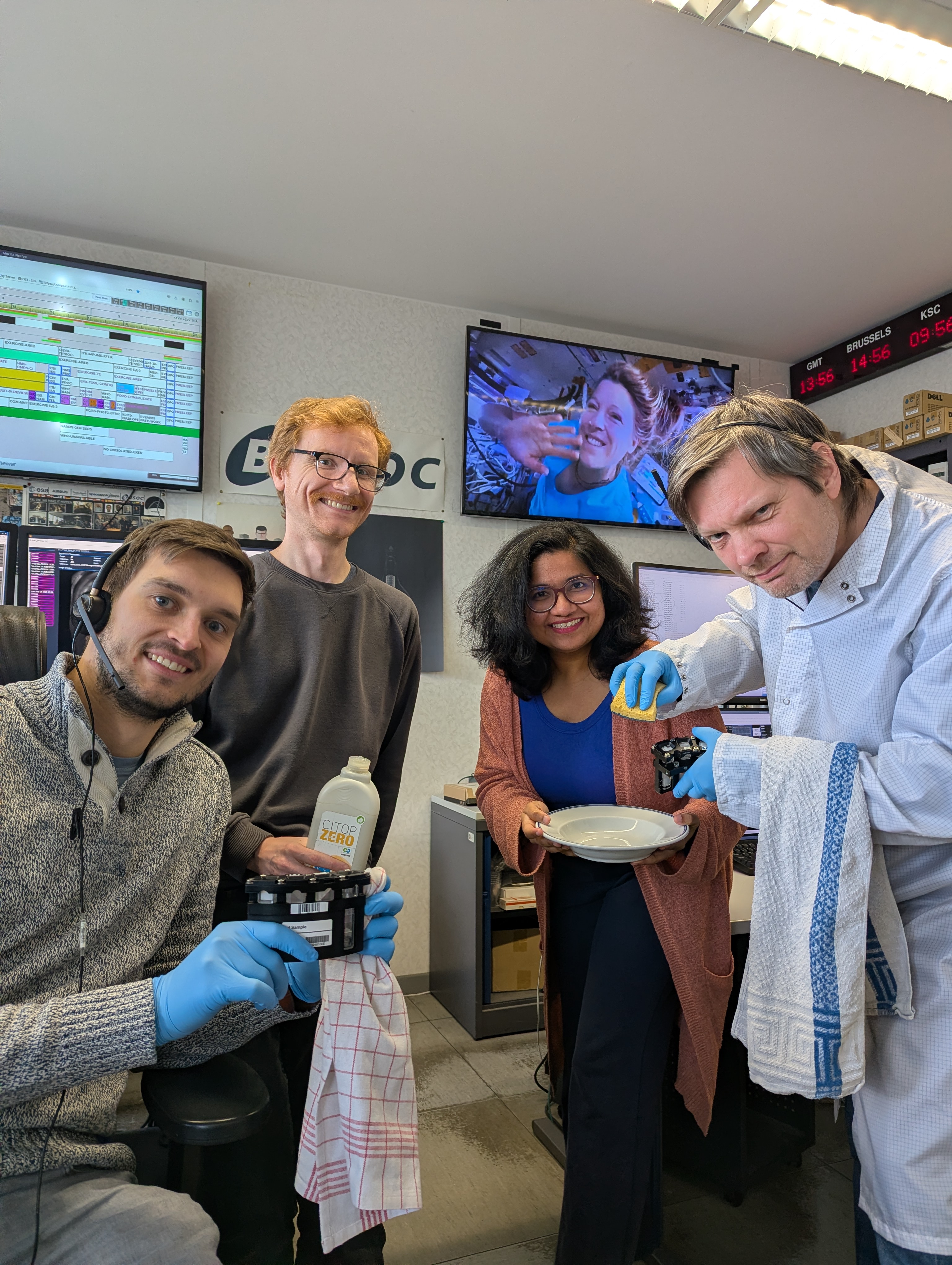
Update 25/03/2026: In February, the activity was postponed due to leaking oil in the new sample cells. Following a review, the Columbus Anomaly Resolution Team has decided to proceed with cleaning the observed oil residue and installing the new sample cells as originally planned. The installation was successfully completed today at approximately 11:30 Brussels time. As a funny take, the operators took a picture for Sophie, pretending to clean sample cells in the B.USOC control room.
Fluid Science Laboratory
The FSL is a scientific payload located in the Columbus module on board the ISS. It is designed to conduct fluid dynamics science experiments in microgravity. Different experiments have been conducted within FSL, notably with the SMD experiment container, which allows for the study of soft matter such as granular material, foams, gels and emulsions. Within the SMD experiment container, the sample cells are agitated by a piston movement and then monitored by multiple cameras and sensors to study their behaviour in microgravity. Between two batches of science runs, the samples are exchanged by an astronaut on board the ISS, under the instruction and guidance of operators at B.USOC in charge of FSL.
B.USOC is responsible for the experiment preparation, interactions with stakeholders (scientists, the payload developer, Columbus control centre, and NASA), operation and monitoring of the experiment, reception of the telemetry data, and the transfer of scientific data to scientists for analysis.
PASTA in Space!
The samples for this activity, known as “PASTA,” belong to the “PArticle STAbilized emulsions” experiment, which uses the SMD container to study the stability of different emulsions. Emulsions are mixtures of two or more liquids that are not usually able to mix, such as oil and water.
PASTA-3 refers to the third round of PASTA samples to be studied since the PASTA commissioning and science campaign launched in 2022. Before each mission iteration can start in space, a Mission Readiness Test takes place at the BIRA-IASB premises where the operational procedures and the flight sample cells are verified before eventually being sent to the ISS for use in FSL. For this type of test, B.USOC uses an Engineering Model of the FSL: an almost exact copy of the rack on board.
The sample cells to be installed by Sophie are part of a batch of eight PASTA-3 sample units brought to the ISS in September 2025 aboard the Cygnus NG-23 vehicle and stowed in the Columbus module. A first set of sample cells was installed by U.S. astronaut Jonny Kim on the 29th of September, 2025.
A two-part mission
During the crew activity on the 29th of September 2025 when the SMD container was replaced due to hardware malfunctions, 5 of the 8 available PASTA-3 sample units were installed in the carousel of the SMD container. The SMD carousel can house a maximum of 5 sample units, with each sample unit holding four separated cells. Sophie will exchange 3 of the already installed PASTA-3 sample units with 3 new ones. The removed samples will be stowed away onboard the ISS until they are eventually returned to Earth for further analysis.
The samples will be investigated over a period of 4 months, during which B.USOC will operate and monitor the experiment, and collect the telemetry and camera images.
The Final Chapter of the FSL Mission
The FSL mission is scheduled to end in the summer of 2026, with science operations continuing until June. After more than 18 years on board the ISS and having been manned by countless astronauts and USOC personnel across Europe, B.USOC will lead the decommissioning activities for FSL. Considering FSL was initially designed for an operational lifetime of 10 years, its end-of-mission over 8 years later is a celebratory occasion for B.USOC.
More information:
- Belgian User Support and Operations Centre (B.USOC)
- PASTA: understanding how emulsions like mayonnaise work through microgravity research (BIRA-IASB news article)
- PASTA behind the scenes, a B.USOC operator explains (You Tube video)
- Official start of ESA astronaut Sophie Adenot’s εpsilon mission (ESA news article)
News image 1

News image legend 1
News image 2

News image legend 2
News image 3
